
Thanks for the web reference, very useful. So, flow increase is not simply the same ratio of increase as that seen on the fuel rail (see above formula). Obviously an increased fuel supply pressure (to the fuel pressure regulator) would see an increase in fuel rail pressure. I expect this is NOT a 1:1 increase. Correct?
This formula starts by assuming you know the fuel rail pressure. Apart from actually measuring it what's the formula for calculating fuel supply to fuel rail pressure? Please ignore me here if I'm being a dummy!
If using the Walbro 255 pump what increase in fuel supply pressure can be expected on a EURO MY03 2.0 WRX?
Assuming the stock fuel maps were happy fueling at 95% IDC. If one upgrades the pump and calculates that fuel rail pressure increases by say 10% we should be able to make a 10% reduction in IDC, correct?
What's the best way to reduce IDC by 10% - simply adjust the injector scaling value or reduce all fuel maps by 10%? If the injector scaling value needs adjustment, what's the formula for a 10% reduction?
95% Injector Duty on Stock ECU - is this right?
Moderator: Freon
28 posts
• Page 2 of 2 • 1, 2
 by crispyduck » Fri Mar 03, 2006 11:56 am
- crispyduck
- Posts: 186
- Joined: Sun Nov 13, 2005 1:15 pm
- Location: www.scoobypedia.co.uk
by crispyduck » Fri Mar 03, 2006 12:07 pm
Kha0S wrote:What's important to realize is that, no matter what the capacity of your pump, if the FPR doesn't change, the pressure at the injector will be the same, and the flow will not change.
Just seen Kha0s' post. Is this correct? I, perhaps incorrectly, thought that the FPR maintained pressure in proportion (not 1:1) to supply pressure. Can anyone else clarify the situation here?
- crispyduck
- Posts: 186
- Joined: Sun Nov 13, 2005 1:15 pm
- Location: www.scoobypedia.co.uk
by ahains » Fri Mar 03, 2006 12:26 pm
Kha0S wrote:ahains wrote:I'm not saying this is definitely a problem on a WRX, I'm only saying that observing fuel trims will not generally detect this kind of problem. It may very well be that the WRX OEM FPR can handle an upgraded pump just fine.
Perhaps, but my injector duty cycles and AFRs didn't change when installing a high-pressure capable Walbro 255... so it's empirical evidence that with the common pump upgrade on these cars, it doesn't buy you anything without changing the regulator.
Were you measuring AFR with a wideband o2 sensor? If so that's awesome, very good info to have!

Anyone flowing a similar amount of air as you, or more, should have similar results.
If you were going off of the stock O2 sensor, then it still may be that you are totally overrunning the stock FPR and dumping massive fuel at high duty cycle. Injector duty cycles would not be a meaningful measurement since the ECU would "think" it was injecting the proper amount of fuel, it would just be incorrect in this case.
- ahains
- Posts: 83
- Joined: Mon Jun 06, 2005 12:59 pm
- Location: Renton, WA
by Kha0S » Fri Mar 03, 2006 12:29 pm
ahains wrote:Kha0S wrote:Were you measuring AFR with a wideband o2 sensor? If so that's awesome, very good info to have!
Anyone flowing a similar amount of air as you, or more, should have similar results.
If you were going off of the stock O2 sensor, then it still may be that you are totally overrunning the stock FPR and dumping massive fuel at high duty cycle. Injector duty cycles would not be a meaningful measurement since the ECU would "think" it was injecting the proper amount of fuel, it would just be incorrect in this case.
Confirmed via wideband O2, a TechEdge WBO2 20A unit.
- Kha0S
- Posts: 106
- Joined: Tue Jan 11, 2005 12:30 pm
- Location: MY02 USDM WRX / Nashua, NH
by ahains » Fri Mar 03, 2006 1:41 pm
crispyduck,
FPR's work like this:
Fuel pump operates at a given duty cycle. I believe the stock WRX is something like 33%, 66%, or 99% (i.e. 100%). Could be wrong, but I think I saw that in my logs. I recall on my MR2 that it had two speeds - slower and faster.
At a given pump duty cycle, it is chugging some fuel down the fuel rail.
The gas goes to the fuel injectors, and it goes to the fuel pressure regulator.
The fuel pressure regulator can be thought of as a bleeder valve.. it allows some amount of fuel to go back to the gas tank by way of a return line.
It is like a ball & spring boost controller - it tries to maintain some particular pressure at the entrance to the fuel injectors, so it allows however much fuel back into the gas tank to maintain that pressure. If the fuel pump were to speed up (higher duty cycle) for a given amount of fuel needed, the FPR would allow however much additional fuel out its return line (to the gas tank) to keep the fuel pressure at its target.
However, it's a bit trickier. The amount of fuel going through the injectors is due to the *difference* between the pressure on both sides of it. So if the fuel rail has 46psi and the intake port of the head has 0psi, then you have 46psi of pressure differential. This is what determines how much fuel sprays through the nozzle.
As you can see, when you hit 15psi of boost in the intake port you would only have 31psi of pressure differential. This is why FPR's in a turbo application are boost referenced.. they have a connection to the intake manifold (or somewhere), and this causes the same increase in the fuel rail.
So if you have 46psi regulated in the fuel rail from the FPR with 0psi in the intake ports, it will automatically (by simple mechanics, no fancy electronics) increase to 61psi in the fuel rail for 15psi in the intake port.
Note that the fuel pump doesn't know a thing about the intake port pressure. It sees the pressure in the fuel rail, 61psi. Any aftermarket fuel pump will have a graph that shows how much volume it can flow at a given pressure. I pump that can flow tons of cc/minute at 40psi may be able to barely flow any cc/minute at 90psi. This may very well not be an issue in many cases, but definitely can be in the case where you are bumping up pressure to simulate larger injectors.
HTH!
FPR's work like this:
Fuel pump operates at a given duty cycle. I believe the stock WRX is something like 33%, 66%, or 99% (i.e. 100%). Could be wrong, but I think I saw that in my logs. I recall on my MR2 that it had two speeds - slower and faster.
At a given pump duty cycle, it is chugging some fuel down the fuel rail.
The gas goes to the fuel injectors, and it goes to the fuel pressure regulator.
The fuel pressure regulator can be thought of as a bleeder valve.. it allows some amount of fuel to go back to the gas tank by way of a return line.
It is like a ball & spring boost controller - it tries to maintain some particular pressure at the entrance to the fuel injectors, so it allows however much fuel back into the gas tank to maintain that pressure. If the fuel pump were to speed up (higher duty cycle) for a given amount of fuel needed, the FPR would allow however much additional fuel out its return line (to the gas tank) to keep the fuel pressure at its target.
However, it's a bit trickier. The amount of fuel going through the injectors is due to the *difference* between the pressure on both sides of it. So if the fuel rail has 46psi and the intake port of the head has 0psi, then you have 46psi of pressure differential. This is what determines how much fuel sprays through the nozzle.
As you can see, when you hit 15psi of boost in the intake port you would only have 31psi of pressure differential. This is why FPR's in a turbo application are boost referenced.. they have a connection to the intake manifold (or somewhere), and this causes the same increase in the fuel rail.
So if you have 46psi regulated in the fuel rail from the FPR with 0psi in the intake ports, it will automatically (by simple mechanics, no fancy electronics) increase to 61psi in the fuel rail for 15psi in the intake port.
Note that the fuel pump doesn't know a thing about the intake port pressure. It sees the pressure in the fuel rail, 61psi. Any aftermarket fuel pump will have a graph that shows how much volume it can flow at a given pressure. I pump that can flow tons of cc/minute at 40psi may be able to barely flow any cc/minute at 90psi. This may very well not be an issue in many cases, but definitely can be in the case where you are bumping up pressure to simulate larger injectors.
HTH!
- ahains
- Posts: 83
- Joined: Mon Jun 06, 2005 12:59 pm
- Location: Renton, WA
by ahains » Fri Mar 03, 2006 1:47 pm
Kha0S wrote:Confirmed via wideband O2, a TechEdge WBO2 20A unit.
Slick. Is your car essentially stage 1, no major mods? If so, I think that pretty will confirms that the OEM WRX FPR is fine for an upgraded pump. Cool beans!
OTOH If you're massively upgraded, it may only apply to massively upgraded cars and not near-stock cars.
Thanks!
- ahains
- Posts: 83
- Joined: Mon Jun 06, 2005 12:59 pm
- Location: Renton, WA
by crispyduck » Fri Mar 03, 2006 11:40 pm
ahains, thanks for the detailed description of how FPRs work in turbo cars. I had it very wrong, but understand now.
As you've demonstrated there, upgrading the pump only will do nothing unless the exisiting pump was faulty or failing to keep up with your existing mods.
So, investigating upgraded FPRs a little ... I would not want an aftermarket one as I've heard too many scary stories about one particular brand. I'm thinking that Subaru may use different spec ones on their various Impreza models e.g. WRX compared with STi. Does anyone know the specifications of the standard WRX FPR and an STi one? Are they the same in a EURO MY03? Already know STi's have larger injectors, just trying to see if there are any other (cheeper) solutions other than larger injectors. I'm thinking with an upgraded pump and higher pressure FPR I can simulate slightly larger injectors.
-Steve.
As you've demonstrated there, upgrading the pump only will do nothing unless the exisiting pump was faulty or failing to keep up with your existing mods.
So, investigating upgraded FPRs a little ... I would not want an aftermarket one as I've heard too many scary stories about one particular brand. I'm thinking that Subaru may use different spec ones on their various Impreza models e.g. WRX compared with STi. Does anyone know the specifications of the standard WRX FPR and an STi one? Are they the same in a EURO MY03? Already know STi's have larger injectors, just trying to see if there are any other (cheeper) solutions other than larger injectors. I'm thinking with an upgraded pump and higher pressure FPR I can simulate slightly larger injectors.
-Steve.
- crispyduck
- Posts: 186
- Joined: Sun Nov 13, 2005 1:15 pm
- Location: www.scoobypedia.co.uk
by FrSTi » Sat Mar 04, 2006 1:00 am
ahains wrote:crispyduck,
FPR's work like this:
Fuel pump operates at a given duty cycle. I believe the stock WRX is something like 33%, 66%, or 99% (i.e. 100%). Could be wrong, but I think I saw that in my logs. I recall on my MR2 that it had two speeds - slower and faster.
At a given pump duty cycle, it is chugging some fuel down the fuel rail.
The gas goes to the fuel injectors, and it goes to the fuel pressure regulator.
The fuel pressure regulator can be thought of as a bleeder valve.. it allows some amount of fuel to go back to the gas tank by way of a return line.
It is like a ball & spring boost controller - it tries to maintain some particular pressure at the entrance to the fuel injectors, so it allows however much fuel back into the gas tank to maintain that pressure. If the fuel pump were to speed up (higher duty cycle) for a given amount of fuel needed, the FPR would allow however much additional fuel out its return line (to the gas tank) to keep the fuel pressure at its target.
However, it's a bit trickier. The amount of fuel going through the injectors is due to the *difference* between the pressure on both sides of it. So if the fuel rail has 46psi and the intake port of the head has 0psi, then you have 46psi of pressure differential. This is what determines how much fuel sprays through the nozzle.
As you can see, when you hit 15psi of boost in the intake port you would only have 31psi of pressure differential. This is why FPR's in a turbo application are boost referenced.. they have a connection to the intake manifold (or somewhere), and this causes the same increase in the fuel rail.
So if you have 46psi regulated in the fuel rail from the FPR with 0psi in the intake ports, it will automatically (by simple mechanics, no fancy electronics) increase to 61psi in the fuel rail for 15psi in the intake port.
Note that the fuel pump doesn't know a thing about the intake port pressure. It sees the pressure in the fuel rail, 61psi. Any aftermarket fuel pump will have a graph that shows how much volume it can flow at a given pressure. I pump that can flow tons of cc/minute at 40psi may be able to barely flow any cc/minute at 90psi. This may very well not be an issue in many cases, but definitely can be in the case where you are bumping up pressure to simulate larger injectors.
HTH!
That is an almost perfect description

I would just add that pump displacement is also related to the supply voltage.
Anybody ever checked how much V you get on the pump with the stock installation, contoller and wiring ?
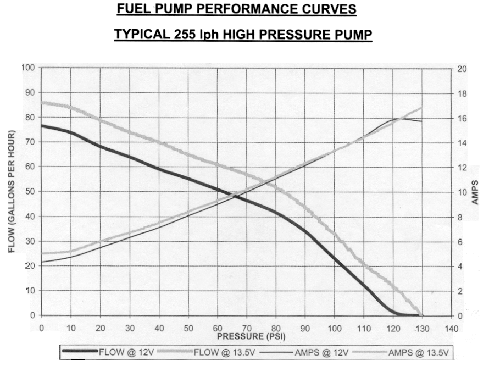
It seems many fellows here do not realise the flow (the engine demand) and pressure are definately related.
Reaching max power rpm, both manifold pressure and demand are at their maximum : with 3.0b differential fuel press. and 1.5b boost, the pump has to push 4.5b to feed the injectors with the correct amount of fuel.
All pumps have non-linear volume to pressure capacity, the flow is considerably reduced when pressure increases.
I found this chart for the very popular Walbro 255L "Hi-press" version.
This may assist to clarify
- FrSTi
- Posts: 79
- Joined: Wed Jun 29, 2005 6:09 am
- Location: facing my laptop
by FrSTi » Sat Mar 04, 2006 1:08 am
So, sorry to insist, but the easiest way to make sure you are supplying the correct amount of fuel is to fit a WB kit.
This is the only way to have an overall view on the fueling system... really worth the 350$
This is the only way to have an overall view on the fueling system... really worth the 350$
- FrSTi
- Posts: 79
- Joined: Wed Jun 29, 2005 6:09 am
- Location: facing my laptop
by Kha0S » Sat Mar 04, 2006 4:57 am
crispyduck wrote:So, investigating upgraded FPRs a little ... I would not want an aftermarket one as I've heard too many scary stories about one particular brand. I'm thinking that Subaru may use different spec ones on their various Impreza models e.g. WRX compared with STi. Does anyone know the specifications of the standard WRX FPR and an STi one? Are they the same in a EURO MY03? Already know STi's have larger injectors, just trying to see if there are any other (cheeper) solutions other than larger injectors. I'm thinking with an upgraded pump and higher pressure FPR I can simulate slightly larger injectors.
That's exactly my plan. I'm going to run a +10psi FPR with my aftermarket high-pressure pump, which should get my IDCs back down into the 80s. As the ambient temps start to go back up into summertime, I'm likely to invest in water/methanol injection, which should allow me to pull back the AFRs to 12.5:1 with lots of fuel headroom, and run a ported turbo on the car.
There's apparently an FPR out there on some of the JDM STis that is stamped "STi" on the side and runs 10psi higher static pressure... you can also take a stock FPR and press the can in some more, which will recalibrate it for a higher static pressure... or, if you're lucky enough to know someone with an FPR jig...
FrSTi wrote:So, sorry to insist, but the easiest way to make sure you are supplying the correct amount of fuel is to fit a WB kit.
Absolutely. I wouldn't dream of trying to tune my car without a wideband.
/Andrew
- Kha0S
- Posts: 106
- Joined: Tue Jan 11, 2005 12:30 pm
- Location: MY02 USDM WRX / Nashua, NH
by crispyduck » Sun Mar 05, 2006 8:40 am
Sorry to be harping on about this still, especially after all the great advice above but ... I've just read a post on ScoobyNet from Bob Rawle which says:
I don't want to take his comments out of context so please feel free to read the reference thread above (up to post #9).
After all your advise so far I was happy that we were drawing the pump/pressure/FPR/IDC issues to a conclusion. Can we take a final look at this and put this one bed? I just can't understand why someone would recommend a remap when only an uprated pump was changed.
"... whichever reg you keep to fitting an uprated fuel pump will cause the car to be fueled more heavily ... the uprated pump can supply more fuel flow for any given pressure within the flow limits of the regulator which is why a remap is recommended"
Source: ScoobyNet - will i have to have it remapped again after fitting walbro pump? thread.
I don't want to take his comments out of context so please feel free to read the reference thread above (up to post #9).
After all your advise so far I was happy that we were drawing the pump/pressure/FPR/IDC issues to a conclusion. Can we take a final look at this and put this one bed? I just can't understand why someone would recommend a remap when only an uprated pump was changed.
- crispyduck
- Posts: 186
- Joined: Sun Nov 13, 2005 1:15 pm
- Location: www.scoobypedia.co.uk
by JimbobUK » Sun Mar 05, 2006 9:37 am
Perhaps you can look at it like this:
Your old pump wasn't quite cutting the mustard with your current setup - hence if you assume that your maps have been biased at high load to compensate (to some degree) for this dip in pressure at high load.
You then change to a pump that can keep up the desired pressure at the higher flow rates, and hence the top-end bias is now causing undesired enrichment. Hence the need for remap..
Then again, perhaps tuners don't add this type of bias to the map to work-around a weak pump?
Plus, BRD are in the market for selling remaps, so that may have something to do with the statement.
Your old pump wasn't quite cutting the mustard with your current setup - hence if you assume that your maps have been biased at high load to compensate (to some degree) for this dip in pressure at high load.
You then change to a pump that can keep up the desired pressure at the higher flow rates, and hence the top-end bias is now causing undesired enrichment. Hence the need for remap..
Then again, perhaps tuners don't add this type of bias to the map to work-around a weak pump?
Plus, BRD are in the market for selling remaps, so that may have something to do with the statement.
- JimbobUK
- Posts: 36
- Joined: Thu Sep 29, 2005 12:28 pm
by FrSTi » Mon Mar 06, 2006 8:32 am
crispyduck wrote:Sorry to be harping on about this still, especially after all the great advice above but ... I've just read a post on ScoobyNet from Bob Rawle which says:"... whichever reg you keep to fitting an uprated fuel pump will cause the car to be fueled more heavily ... the uprated pump can supply more fuel flow for any given pressure within the flow limits of the regulator which is why a remap is recommended"
Source: ScoobyNet - will i have to have it remapped again after fitting walbro pump? thread.
I don't want to take his comments out of context so please feel free to read the reference thread above (up to post #9).
After all your advise so far I was happy that we were drawing the pump/pressure/FPR/IDC issues to a conclusion. Can we take a final look at this and put this one bed? I just can't understand why someone would recommend a remap when only an uprated pump was changed.
This statement is mainly applicable to classics, quite a lot of stk FPR obviously get "overpumped".
On new age cars, it's not such obvious... IMHO.
Thanks to the fuel pump management.
- FrSTi
- Posts: 79
- Joined: Wed Jun 29, 2005 6:09 am
- Location: facing my laptop
28 posts
• Page 2 of 2 • 1, 2
Who is online
Users browsing this forum: No registered users and 1 guest